
If you are driven to become the best diver you possibly can, this article is for you.
The questions from my divers are usually in these categories:
- How can I get better and express my full potential?
- When is the right moment to push our limits?
- How many courses do I need to take?
To give a proper answer, we need a powerful introduction!
This is how I approach any project or challenge:
“Decide with your heart, plan with your brain, and act with your balls!”
Now let’s put it into context.
Step #1: Deciding with your heart
There must be a powerful emotional decision, based on what makes us happy, regardless of whether it makes sense or not.
Pushing your limits as a technical diver, a cave diver, or a free diver has nothing to do with logic.
It’s something you feel compelled to do because of how it makes you feel.
Let logic and fear of failure be in the background, and focus on what would make you really feel happy and alive. Think about doing that, without any limiting factors, such as money, time, and risk.
You might find yourself saying something like this:
“I want to become a cave diver because I like the inner challenge and the underwater caves!”
“I accept the risks and nothing can stop me!”
Step #2: Plan with your brain
Now it’s time for the reality check! We need to plan how to achieve our goals in the most efficient way possible, based on realistic expectations.
Just because you want something doesn’t mean you will get it, or that you deserve it! You have to work smart and hard. This is the moment to work smart.
Let’s say that you are an advanced open water diver with 50 dives. Any decent cave instructor would recommend that you come back when you have a few hundred dives and your diving skills are excellent.
There is no room during a tech course for learning how to control your buoyancy and propulsion; they must already be good. Maybe he also encourages you to take a nitrox course.
Now you know that you must find the time to dive at least once a week for one or two years.
There is no other course you can take that is going to speed up the process, but you definitely need to work on your skills.
If formal training is not a solution, there are two other options. You can take private classes to improve your skills, or you can train during your fun dives.
I like to categorize the fun dives into two groups:
- Experimentation
- Execution
Experimentation dives are conducted in a safe environment, where you can test your skills and your equipment without risks to you and your buddy. It can be a pool or a shallow reef. The purpose of the dive is to train, not to see fish. Your teammate must agree on the plan and assist you! These are the occasions when you can really push your limits and learn from yourself.
“Go to the pool and make experiments as often as you can, and be safe. You can tune your skills more than during your fun dives!”
The execution dives are the ones where we put our skills to work to complete a dive plan. There is no room for improvisation and experimentation. Everything has been planned, and now it’s time to perform according to our current level.
“If you go on a liveaboard, you are there just to dive; you don’t make experiments with your equipment while dodging hammerhead sharks in the current!”
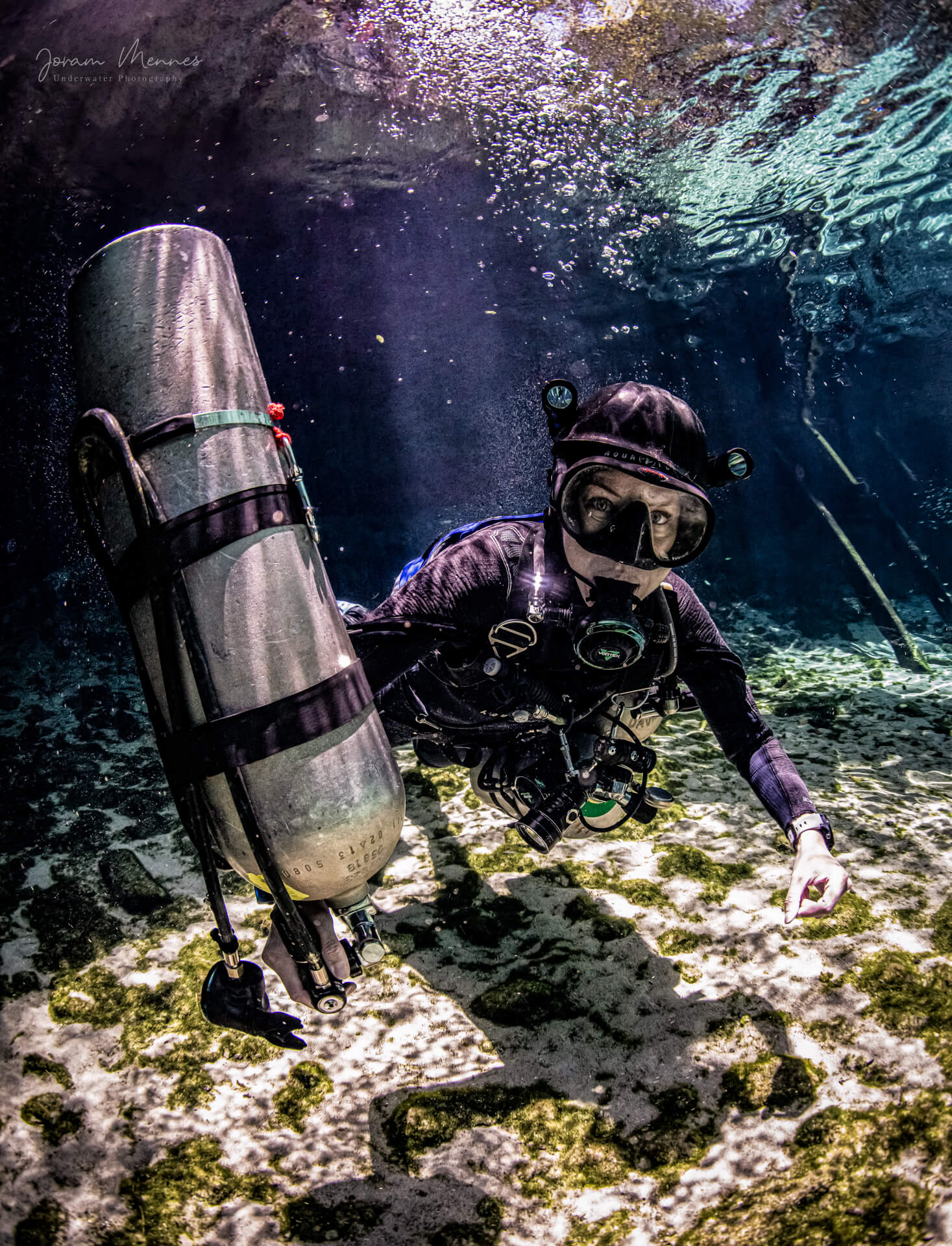
Test your equipment in a confined environment.
Step #3: Act with your balls
Continuing with our example, digesting that becoming a cave diver will take much longer than expected, and still going for it is how you demonstrate to yourself what you are made of!
You have to process that it will take a while, it’s going to be expensive, and there are no guarantees of success.
You might literally die trying, but after all, there is nothing else you would rather do!
The initial motivation and excitement usually fade away once the first problems and difficulties arise.
This is the natural selection process, where only the fittest survive.
In this case, we are not talking strictly about the physical conditions, which are a critical factor, but more about the mindset. Expecting problems and obstacles is part of the plan. Making mistakes and having setbacks should be taken into account.
Your commitment to success is the only way to overcome the adversities and the challenges. Nothing valuable is obtained easily. If you don’t feel like giving up at least once a week, you are not trying hard enough!
In my career, I’ve met incredible men and women, instructors and students, who inspired me to do better.
The efforts and dedication I witnessed are worth more than just a certification card; it’s who they become!
“If during your journey you also happen to inspire others, your efforts will be worth even more!”
“You will become your best piece of art, while still being a constant work in progress until the end!”